IGS Educate The Educators Marks 10 Years
One of the IGS's most innovative and impactful teaching programs celebrates a decade of activity this month. The IGS Educate the Educators (EtE) initiative was developed to raise the profile of...
| 28 Jul 2025 | |
| Educate the Educators News |
One of the IGS's most innovative and impactful teaching programs celebrates a decade of activity this month.
The IGS Educate the Educators (EtE) initiative was developed to raise the profile of geosynthetics materials in universities and other teaching institutions.
The aim was to ensure all students on an undergraduate engineering program left with a basic grounding in geosynthetics. The route – by first educating the tutors, professors and teaching staff, who could incorporate their learnings into curricula.
From a core 50-minute introductory lecture on geosynthetics 10 years ago, the program has blossomed into a rich suite of online and in-person resources available today.
In the first of a series of articles marking the anniversary we look back at the EtE's origins and those involved in its development. Later you can read about current activity, and what the future holds for IGS outreach.
****
Educate the Educators started life in the late-90s' corridors of North American academia.
Dr. David Elton, a former editor of the IGS News, was already delivering a similar scheme, called the Professor Training Course for Geosynthetics from around 1998, which inspired the current EtE program delivered today.
He said: "I came up with the initial concept, which was conceived out of the need for university-level geosynthetics instruction. I was one of maybe five US instructors teaching a geosynthetic course at the time, in my case, at Auburn University, Alabama. The good enrolment showed the desire for geosynthetics education."
Dr. Elton, now Professor Emeritus of the Civil and Environmental Engineering Department at Auburn University, said the format was modeled on the National Center for Asphalt Technology Professor Training Course for asphalt pavements being taught at Auburn at the time.
"We used six instructors, each of whom prepared and distributed class notes, samples, and software taken home by the attendees and used to form a standalone geosynthetics course. By design, the modular nature of the notes allowed them to be inserted, in part, into existing Civil and Environmental Engineering courses, for those that couldn't form a standalone course," he said.
Only available in North America at the time, the course comprised six lectures on filtration and drainage, landfills (environmental), slopes, walls, erosion control, and pavements. It was funded externally by bodies including the IGS, Geosynthetic Institute, Federal Highway Administration, National Science Foundation, International Erosion Control Association, North American Geosynthetics Society, and Auburn University, and lasted five days.

"They funded everything except the attendee's travel. This was critical to the mission of the course – to include instructors from all levels of universities – rich and poor," he said.
"The course ran for five or six years, at which time the pool of interested professors was depleted, so we made like the Lone Ranger and said, 'Our work is done here.'"
However, thanks to the groundwork laid by Dr. Elton and his colleagues, the idea was far from over and reemerged around a decade later, spearheaded by then-President of IGS North America (NA) John Henderson, then-IGS Secretary Elizabeth Peggs, Professor Jorge Zornberg, of the University of Texas at Austin, and Boyd Ramsey.
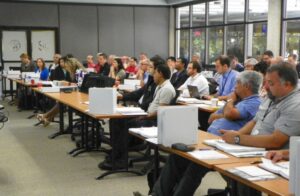
Renamed Educate the Educators, a debut event was held in Austin, Texas, on July 28-29, 2015, with instructors Prof. Richard Brachman, of Queen's University, Canada, geotechnical consultant Dr. Barry Christopher, and Prof. Zornberg delivering the core 50-minute 'introduction to geosynthetics' lecture.
Currently President of the Americas region for Solmax, Mr Henderson said: "Setting up Educate the Educators in 2015 was an incredible experience. Professionals from diverse backgrounds and companies came together with a shared goal of advancing the industry. The collaboration and energy made it truly memorable. It was also incredibly gratifying to see the strong interest from educational institutions."
Responses to a survey following the event showed almost half of those surveyed would be adding geosynthetics content to their curriculum as a result of attending.
Mr Henderson said one of the challenges was securing time from volunteers who already had full-time commitments, so those involved showed great passion and dedication in seeing the program succeed.
One of those was Prof. Brachman, who followed Mr Henderson as IGS NA President and served as Chair and one of the instructors on the EtE program from 2015 to 2019. He got involved "because of a firm belief that we can improve practice by improving university education".
He recalls of 2015's event: "Forty-five professors participated, of which 45% had six or fewer years of experience, 25% had seven to 10 years of experience and 30% had 11 or more years of experience. This led to excellent exchanges between the participants on education content and delivery method."
He continued: "In the program's reimagined form, I valued the chance to devise and develop a program focussed on easy uptake and effective implementation in university programs.
"The main challenge was and still is getting any sort of new content into already jammed packed curricula and providing instructors with modern and effective teaching materials that they can use at their own schools, for example technical slides, fantastic pictures – thank you IGS photo competitions – case histories and hands-on learning samples."
Fellow instructor Dr. Barry Christopher, also a Past President of IGS NA, had extensive experience in developing and delivering geosynthetics courses since 1984 so was an integral member of the training team.
"It was a privilege to be part of this inaugural class, which set a strong foundation for future EtE courses," he said.
"One of the key challenges we faced was the advanced knowledge of the audience, especially compared to the earlier US Professor Training Course for Geosynthetics program, when geosynthetics was an emerging topic. In fact, several of our professional peers attended this class and their feedback, along with that of other participants, confirmed the program's success.
"Another challenge stemmed from the limited instructional time available to university professors to teach this subject, typically only a few hours within a semester, so we designed the content accordingly, keeping accessibility in mind."
Mr Henderson, summing up why supporters feel so passionately about ensuring EtE's continued success, said: "Far too many engineering students enter the workforce with limited exposure to geosynthetics. By integrating foundational knowledge at the undergraduate level, we can accelerate industry-wide understanding and adoption, ultimately driving broader acceptance and innovation in geosynthetics."
Boyd Ramsey, also part of the IGS Foundation which funds many EtE opportunities, said: "I don't think those of us who organized and executed the Austin event in 2015 had any idea of the impact our work and efforts would have. Ten years on, Educate the Educators has been one of the most, if not the most successful IGS program with 30 events held around the world, and online content, and over 1,000 professors and others being taught 'how to teach geosynthetics'.
"I want to thank everyone for their efforts in bringing to life this wonderful program that has had, and will continue to have, so many benefits and positive effects on our industry and the world. We made something wonderful."
Watch this space for more about the legacy of EtE where you can read about exciting plans for the future.
Step back in time to view archive photos of EtE Austin 2015.